Built to keep your secrets secret.
A self-hosted gateway that inspects and controls what your network sends to the web.
Polymux™ sits between your machine or network and the internet. Before a request leaves, it swaps real values (credentials, personal data, internal hostnames and addresses) for tokens, and the reply comes back with the real values restored.
- Keeps values home. Tokens go out; the real values stay with you.
- Controls what goes out. Blocks destinations and AI tool calls you have not approved.
- Keeps a record. A tamper-evident log of what was allowed and what was stopped.
- Governance for teams: who can send what, where, and how much.
Nothing is Ready yet: some capabilities are Tested, the rest Built or Planned.
Who it is for: Whether you're protecting your home computer and personal secrets, or keeping your team from sending known secrets to an AI endpoint you don't control, Polymux is built to sit in the path and catch it.
Limits: Polymux matches known value shapes (credentials, keys, personal data, hostnames, IPs and your own patterns). It does not judge meaning, so prose and encoded or compressed payloads can slip past. Details below.
Editions: a Personal, single-machine edition follows the preview, then Team and Enterprise editions. Target dates are under Maturity.
Two requests, two outcomes.
This example is representative of a run on the same enforcement path the automated suite drives: a 403 on the secret, and a 200 with the infrastructure tokenized. The host, address and token identifiers are illustrative, and the tokens are shortened. The provider is sent tokens in place of the real names, and your team gets the real values restored in the reply.
This has a cost: the model loses your topology. It cannot infer which environment a host belongs to, how your subnets group, or what your naming scheme implies. That is intended. Those relationships are the map an attacker builds first, and withholding them from the model narrows what can leak: to a provider, to a log, or to whoever reads either one later. What survives is everything unrelated to topology: the error in the traceback, the type mismatch in the config, the logic in the code.
One checkpoint for outbound web traffic.
Who can send what, where, and how much.
The aim is evidence that your own reviews and audits can use. Polymux holds no compliance certification, and nothing here claims otherwise. Each item carries its maturity.
Identity first
OIDC SSO (Team and Enterprise), API keys, and workload identity via mTLS or source network. A stream resolves to a team before anything else is decided about it.
Per-team policy and limits
Destination allow and deny lists, model allowlists, and spend limits with soft alerts and hard caps.
Tamper-evident audit
A hash-chained record of enforcement decisions, with an operator verify command.
Reviewed policy changes
Policy changes are signed and rolled out canary-first: a new policy runs on a chosen set of nodes first, then is promoted to the rest (Team and Enterprise). An optional dual-control setting requires the reviewer to be someone other than the person applying the change; it is meaningful with Enterprise admin authentication.
Self-hosted
Polymux runs on your infrastructure, so policy and audit records live in your environment, not a vendor cloud. Your traffic still goes where you send it, with values tokenized on the way out.
Planned items are listed under Maturity.
What is Tested, what is only Built, and what is Planned.
Planned: decided or designed, not finished. Built: written and covered by automated tests. Tested: run end to end through the real program against mock providers and lab clusters. Ready: run on live traffic across a range of scenarios, and signed off by the Founder. Nothing is Ready yet.
- tokenizing hostnames, addresses, credentials and personal data before they leave
- PII, PCI and secret detectors plus custom patterns
- egress allow and deny lists
- per-team policy
- blocking tool calls
- shadow mode
- a hash-chained audit trail
- offline-signed licenses
- spend limits
- signed canary rollout
- malware scanning
- the single-machine Linux install and its first-run polish
- protecting secrets with the machine's own hardware
- an encrypted evidence store with a review step
- complete scanning of streamed replies
- approval and review flows
- audit browsing
- measured detection accuracy
- PHI detectors
- role-based access control for admins
- macOS and Windows
- provider failover
- AWS Bedrock, Google Vertex and GitHub Copilot
- license expiry and trial enforcement
Next: a design-partner preview this winter. A public download of the Personal, single-machine edition is targeted for the first half of 2027, and Team and Enterprise editions for the second half of 2027. These are targets only, so the dates may move with the work. Questions are welcome at any point: development@polymux.io.
Follow along: status and updates or the Atom feed.
Limits: what Polymux does not do
Scope. It handles HTTP and HTTPS traffic, not every outbound protocol.
Detection is pattern-based. It matches known shapes of values: credentials, keys, personal data, hostnames, addresses and your own patterns. It does not read for meaning, so long prose carrying company IP, encoded or compressed payloads, and a person deliberately working around the patterns can get past it.
Failure. A detector that runs and finds nothing is trusted, so detection accuracy matters. Measuring it is Planned.
After data leaves the network, what happens to it is usually unknown.
The perimeter has moved.
Your people paste into other companies' text boxes. Your services, jobs, and agents open connections on their own schedule. The firewall still guards a boundary that much of that traffic passes straight through.
A valid request can still be unauthorized.
A request can pass authentication, schema validation, and every scanner you own, and still carry something, or reach something, that nobody signed off on.
Some calls have no signature.
No pattern matches a call that is wrong only because of who asked, what it carries, and where it is going. That decision has to be deterministic, and it has to be made in-path.
One narrow waist. Every routed stream crosses it.
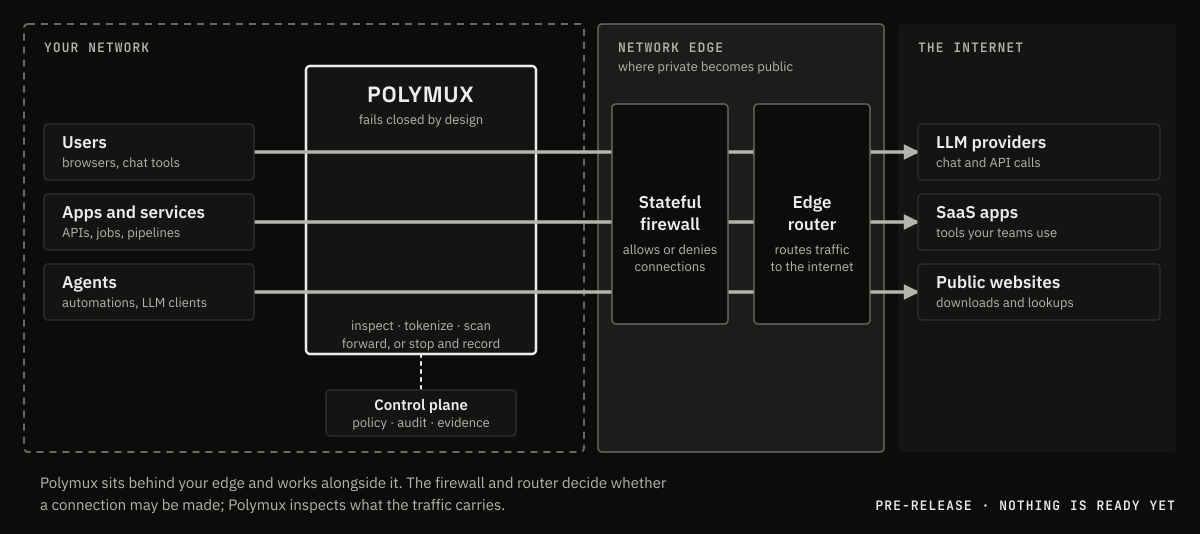
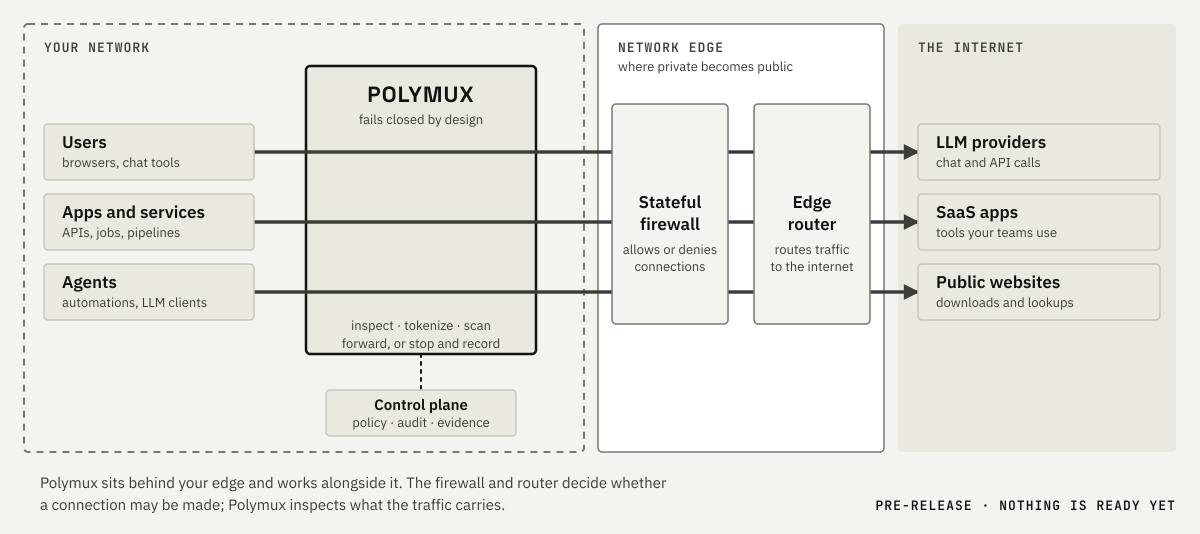
Outbound security is usually split across a dozen products, each seeing a slice and none of them having the last word. Polymux covers one narrow job. The internet is built as an hourglass: countless applications above, countless networks below, one narrow waist between. Polymux gives outbound web traffic the same architecture: users, apps, and agents on one side, the services they call on the other, and a single governed junction between them. The aim is no ambiguous states: a stream is inspected and forwarded, or stopped and recorded.
Streams stay individually isolated as they multiplex through: each authenticated, inspected, and budgeted on its own terms. When an enforcement check fails, or even errors, that stream stops at the waist. A few paths do not behave that way yet and are being worked through. The deliberate exceptions exist to keep the service available, and each is documented as an architecture decision.
Polymux sits behind your edge and works alongside it. A firewall and an edge router decide whether a connection may be made (address, port, destination), and the deep-inspecting ones match signatures and categories on what passes. Polymux adds one more step: it recognizes that a value is yours, substitutes it before it leaves, and restores it in the reply. That step needs to see inside the boundary, so the junction sits inside it.
The two planes are built to fail differently, on purpose. The data plane fails closed by design. The control plane degrades visibly: when its own guard rails trip it boots fenced, stays reachable, and reports unready so that it does not serve. An operator can still reach the instrument that clears the fault.
- 01Authenticate & authorize
- 02Enforce policy & budget
- 03Detect & tokenize
- 04Cache or forward
- 05Scan the response
- 06Govern tool calls
- 07Restore & return
- 08Record to audit chain
Any enforcement stage can stop a stream. When one does, that stream ends at the waist and nothing more is forwarded for it. The others flow on. The stages show the design. What is Tested is listed under Maturity.
What's already standing at the junction.
The cards below give the detail behind Maturity. Each card’s tag gives the stage of its features.
Tokens keep the meaning. Topology is designed to stay home.
- Deterministic tokenization: hostnames, IPs, credentials, and PII become stable tokens before egress, restored in the reply. Tokens keep the relationships a reader still needs, such as which host appeared in both files. Plain redaction replaces every value with one blank and loses them.
- Detector registry: PII / PCI and secret detectors, plus custom patterns defined in policy.
- Malware scanning: ClamAV and optional YARA-X rules.
- Egress control: per-team destination allow and deny lists plus threat-intel reputation: critical-severity hits block, lower severities are flagged.
Permitted or denied, with human approval planned.
- Identity-scoped policy: OIDC SSO (Team and Enterprise), API keys and workload identity via mTLS or source network. Role-based admin access is planned. A stream resolves to a team before anything else is decided about it.
- Tool-call governance: allow or deny per tool, with argument schema validation. Human approval is planned.
- Policy as proposal: changes are reviewed, cryptographically signed, and rolled out canary-first (Team and Enterprise). Automation assists; humans decide.
- Shadow mode: run enforcement as a dry run first. It records what it would have done and takes no action.
Verdicts leave a record.
- Tamper-evident audit: a hash-chained record of enforcement decisions, with an operator verify command.
- Budget governance: per-team spend limits with soft alerts and hard caps, metered in exact integer arithmetic.
- Detection evidence: an optional encrypted store of what the request-side detectors actually saw, and an operator digest over it, so tuning starts from records.
- BYO observability: Prometheus metrics, syslog in CEF / LEEF (Enterprise), OTLP (Enterprise). Your SIEM, your dashboards.
An agent's authority should be checked somewhere the agent can't reach.
The AI features run on the same inspection and enforcement engine. AI is where that engine matters first, because an agent breaks assumptions the rest of the stack still makes: it chooses what to send, it acts on whatever enters its context, and it does both faster than anyone reviews.
A gateway has limits here. It cannot tell which tool call is a mistake, because that judgement needs intent, and Polymux does not claim a detector for intent. It moves the decision off the agent and onto a policy the agent cannot edit, at a point the agent cannot route around when the gateway is its only way out, with a record of what was decided and why. The policy still has to be written. Once it is, it is enforced, and it no longer lives inside the thing that might be compromised.
An agent is steered by what it reads.
Models act on whatever enters their context. A poisoned document looks like ordinary input, so the resulting behavior looks like the agent doing its job.
A tool call is an action.
A tool call is a change to a real system, and by default the code that decides whether to run it is the code being steered. Allow or deny per tool, with arguments validated.
Which models, and how much.
Per-team model allowlists and spend limits, metered in exact integer arithmetic: soft alerts first, hard caps behind them.
Engineering rules already in force.
Fails closed by design. Where possible, the unsafe option is deleted. When the weak token format was replaced, the switch that selected it was deleted. A service started with no environment declared refuses to boot. The control plane cannot clear a safety fence that it is itself subject to. None of those are checks someone has to remember to run. Security refinements and feature coverage are in progress (Maturity lists what is still open), and each fix moves it forward.
The same rule applies to what gets written down. A security product asks you to believe a lot of sentences, so the project's own claims are held to one standard: a claimed guarantee has to be enforced or cited. Where a claim's shape can be checked mechanically, that standard is a build gate: a grant-style claim that does not name the line enforcing it fails the build. Where it cannot be checked mechanically, it is a review duty, and whatever that leaves unresolved is tracked.
More than a hundred architecture decisions are recorded with their reasoning and the alternatives that were considered. The readiness file is generated and carries measurements with named sources. It has no status column. The project also audits itself with one question: what in this repository reads as implemented but isn't? The findings go in the repository, resolved or not.
Built by one person: what that means for you.
Polymux is built and run by the Founder of Synergy Geeks LLC, a single-member company. A buyer is right to ask what that means. The pace is one person's pace, availability is one person's availability, and if that person is unavailable there is nobody to cover.
What reduces that risk today is true of the product itself. Polymux is self-hosted, so it runs on your infrastructure. Its design is written down in recorded architecture decisions and a generated readiness record (see Engineering). Licenses are signed and checked offline. You also deal directly with the person who writes the code. At this stage that is an advantage.
The ambition is to become a vendor large organizations can rely on. Nothing on this page claims that has happened. If continuity matters to your decision, ask what exists and what doesn't. You will get a direct answer.
If your web traffic leaves your network for systems you don't control, a conversation is worth having.
Polymux is pre-release, and nothing is Ready yet (see Maturity). The first deployments will be partnerships, shaped with a few teams who take both outbound traffic and the authority they have handed their software seriously. If your users and workloads are reaching outside infrastructure that matters, the preview shows where it stands, including the rough edges.